Nathan Cruz: The Gold in the Cracks
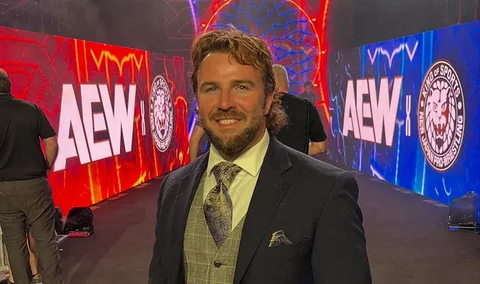
Twenty years ago, a boy from a Hull council estate decided he would become a professional wrestler.
Everything went exactly as envisaged, until those aspirations were ended in a doctor’s room.
This is the story of Nathan Cruz, and of the life that was waiting for him on the far side of a broken dream.
They announced the future of British wrestling on a stage in London, and Nathan Cruz watched it from an overseeing balcony.
Below him, the room was dressed for history. WWE had come to tell the world about the United Kingdom Championship Tournament, with a new brand, a new era, television executives, camera rigs and a generation of British wrestlers about to have their lives changed in front of their families. Somewhere down there were lads he’d shared cars and curtains with for a decade, standing where he was supposed to be standing.
He knew he was supposed to be standing there because he had the paperwork.
“I’d signed my contract,” he says, nine years later, from his home in Hull. “I just needed them to countersign it, and they could no longer do that.”
Ten years of working towards a specific target, from a council estate, to All Star Wrestling, to dark matches against the likes of The Usos, every rung exactly where he’d placed it in his mind as a teenager, with every step along the way going according to plan. He had been good enough, and everyone in that room knew it.
So as he stood on the balcony and cried, Robbie Brookside, the man who’d scouted him, one of the men who built British wrestling, put a hand on his shoulder and said “Don’t worry. We’ll try and sort this”.
It couldn’t be sorted. What ended that specific dream wasn’t a match, or an injury, or politics, or any of the thousand ways wrestling usually breaks its people. Two days earlier, in a quiet room, a cuff had tightened around Nathan Cruz’s arm, and a number came back that decided everything.
—
This month, British wrestling stages the biggest weekend it has ever known. Revolution Pro fills Wembley Arena on Saturday the 29th of August, with AEW’s All In fills the stadium next door the following evening on Sunday the 30th. Somewhere behind the curtain, working as part of the company’s production team, will be the man who was there before any of it, the first Progress Wrestling World Champion, crowned in 2012 at The Garage in Islington, holding not a belt but a staff with an eagle’s head.
It would be easy to write Nathan Cruz as the one who never made it but should have, the nearly man of the British boom, the name his peers spent years puzzling over, but that would also be wrong. Because the strange truth of his twenty years, the truth it took him most of those twenty years to see, is that he did make it. He was simply looking the other way when it happened.
—
Let’s start with the tapes.
There was no Sky television in the Cruz household, no foreign holidays either, no spare money of any kind. “I’m a council estate kid,” he says, with this phrasing being deliberate, not from one, but of one. What there was, instead, was an uncle with a video recorder and a very kind habit of making master tapes for his nephew, be it Batman, X-Men, Power Rangers, and often spliced in among the cartoons, unexplained, occasional episodes of WWF Superstars.
He watched it the way he watched Gladiators, he says. A thing on the telly. His parents, he suspects, did a quiet, deliberate job of hiding from him that wrestling action figures even existed.
Then, at seven or eight, he met a boy at school called Matthew Butler (Matt Myers, as the British wrestling scene would come to know him), and the thing on the telly became the thing itself. They were the only two kids they knew who loved WCW when everyone else was WWF. “I’m an only child,” Cruz says. “He’s the closest thing to kin, as a brother, that I’ve ever had.”
The key conversion moment so many of us have, arrived when he was ten, home ill from school on the weekend of WrestleMania 17, when a neighbour had kindly taped it for him and dropped it over. He can still play the frame in his head, The Undertaker, blood running down his forehead in the Houston Astrodome, surveying his surroundings.
“I remember how that made ten-year-old Nathan feel,” he says. “I knew at that point, I can’t just be a fan of this. I want people to feel how I feel right now.”
He is honest enough, twenty-five years later, to interrogate his own memory. “Whether that’s a narcissistic thing, that I wanted people to look at me the way I looked at Mark Calloway, something changed in me at that point.”
Around him, the estate offered its own commentary with regular reminders “That doesn’t happen for people like us”. He heard it constantly and built his entire adolescence as a rebuttal. “I always had that mindset of, well, someone else has done it. In fact, thousands of people have done it. So why not me? To me, that tells me the limit of your desire, of what you feel you can get out of life.”
There were two driving forces underneath the ambition, and he names both without flinching. The first was his mother, who worked whatever she could work to hide the shape of the household’s troubles from her son, his father, in those years, fighting unemployment and alcoholism. “I’d see my mum doing whatever she could to make sure that I didn’t really know about it,” he says. “And I’d look at my dad and think: I don’t want to end up like that.” He is careful here, protective in both directions. “I love my dad to pieces. Our relationship is completely different now.” But at thirteen, fourteen, the fear of a life spent going nowhere on the estate was fuel, and he burned it.
The second prominent force was a drama teacher, Hayley Buchan, who looked at a council-estate kid having been rushed onto the gifted and talented list and instilled in him, what nobody else was telling him at that time, you can do anything you want, as long as you believe in yourself. When their school won a national performing arts championship and earned the right to compete in Sydney, any other teacher would have filed the invitation somewhere sensible. Buchan fundraised thirty children to Australia. Cruz was sixteen, one year into his wrestling training. He has never forgotten what it taught him about the size of what’s possible.
Years later, a therapist would hand him a small key to himself, when Nathan listens to music, he notices the emotion long before the lyrics. He can tell you where the drop is coming without knowing what the song says. It’s a performer’s wiring, the therapist told him which he had had all along.
—
Before the training school, there was the back garden.
Nathan and Matty didn’t just backyard, they fanatically studied everything they could get their hands on. They carefully watched Tough Enough to learn how to bump, they bought a VHS called The Secrets of Pro Wrestling Exposed, made by the same people behind the Magician’s Code specials, and watched it religiously, then reverse-engineered everything on television against it. How are they throwing these punches? How is that body slam actually working? Two boys on an estate in Hull, running a wrestling promotion of the imagination, filming highlight packages nobody would see for twenty years.
Hull City had no training school, so they caused one to exist. A wrestler called Urban Warrior had begun running low-budget shows at a community centre that held sixty people, where over the PA one night came word that he might bring a training school to Hull. Matty had the internet, and as such, it was Matty, on MySpace or MSN – “that’s how long ago it was” – who talked a hesitant promoter into taking the financial risk, by proving there was a room’s worth of obsessed kids waiting.
Their education was imperfect, with blue gym mats, a real ring perhaps once every six weeks, and lessons that Cruz would later discover ranged from useful to flatly wrong. He refuses the easy revisionism. “Even as bad as that start was, I wouldn’t change it for a thing.”
What it gave him was a door, through which lay the Yorkshire circuit, and through Yorkshire lay the thing he’d seen on the back of a programme as a boy at Hull City Hall, watching All Star Wrestling with Matty, a list of tour dates, and the dawning understanding that British wrestlers could make a living. All Star became Nathan’s entire plan. It was where the WWE scouts looked, with the likes of William Regal having come from there, and so, in Cruz’s teenage cartography, it was the mountain pass. Clear sequential steps were now before him – get good enough for a show, break out into Yorkshire. reach All Star, and begin the climb.
Brian Dixon took him on at the start of 2010, aged nineteen. Suddenly he was wrestling three to five nights a week out of season and up to three times a day through the seven-week summers, which by his reckoning made him the youngest full-time professional wrestler in the world. The All Star dressing room finished his formal education years, with Robbie Brookside, James Mason, Rampage Brown, Dean Allmark, Robbie Dynamite, Nathan’s the childhood favourite, all now colleagues. These colleagues helped fix his diet, sharpened his British style, called him on his mistakes. “I can’t credit that team enough.”
And Hull City got its full-circle night. When NGW, the promotion Cruz and his friends’ generation built, grew big enough to run City Hall, the main event that evening was Nathan Cruz against Matt Myers, for the title, in the exact room where two boys had once sat in the crowd. The audience knew exactly what they were watching and split themselves down the middle. Near the end, the story they told was simple and true, Matty was beaten and too stubborn to stay down, and the only way to win was to knock out his best friend. “It could have easily turned the audience on me,” Cruz says. “Instead it made them fall in love with both of us even more.” Nathan still calls it one of the favourite stories he’s ever told in a ring.
—
The pathway, remarkably, behaved exactly as Nathan the teenager had envisioned it.
Progress arrived in his calendar in 2012 as “a London show”, assumed to be one of the countless one-off promotions that flared and vanished in those years. Then he got there, and there was fruit backstage, water in the fridge, and a t-shirt waiting, with promoters who behaved as though wrestlers were worth looking after. “It was alien to us in 2012.” By the end of the night he’d won an eight-man tournament, beating Marty Scurll in a final that also contained El Ligero, one of his own initial trainers, and become the first champion of a company whose opening poster had asked – Do you remember when wrestling was cool?
The prize was a staff crowned with an eagle’s head. It was never his to keep sadly, and he doesn’t know where it is now. There is something fitting in that, the first symbol of the British boom, mislaid by history, though at the time, what he mostly felt was pressure. He was twenty-one, the youngest champion in the country, the chosen face of something that was obviously about to matter. “Pressure creates diamonds,” he says. “If I’m about to go through a curtain and I don’t feel any nerves, that’s when I’d worry.”
WWE’s machinery, meanwhile, was turning. Drew McDonald, then the UK scout, pulled him aside within months of his All Star debu advising him to get a bit bigger, as he thought Nathan already had what they’d be looking for. When Brookside inherited the scouting role, he already knew the boy’s ambition from a hundred car journeys. Nathan’s first tryout came in 2014, just after WrestleMania 30, where he got to spend a week performing as a Rosebud on Raw and SmackDown, in an Elvis costume, with tech rehearsals, and segments moved twice mid-show. “TV wrestling is so different to pro wrestling. That was the eye-opener. It’s a show, a performance.” He welcomed it.
The backstage culture was a harder lesson. He met, in his phrase, some “odd dickheads”, established industry names with no reason to speak to anyone the way they spoke to everyone. And then, in a corridor, he met the opposite. Dave Bautista had just come back from Guardians of the Galaxy, a pop-culture figure now beyond wrestling entirely, and he stopped a nervous English kid in an Elvis costume with a question, “did you try out today? How do you think it went?”. A thirty-second moment of kindness, that Cruz has carried for over a decade. “He could have just said cheers, mate, bye. I always try to remember those experiences more.”
A callback came in November of that year, with a dark match against The Usos at the Liverpool Echo Arena, teaming with Justin Sysum, who confessed afterwards how heavily he’d been leaning on his partner. In the gorilla position Nathan admitted he could have thrown up. Then, standing in the ring as the Usos came down the ramp, he gave himself the talk. “You’ve worked eight years for this. You’ve manifested this. Now own it. Show them why they should be offering you a full-time deal.”
Afterwards came promo drills, a rehearsed piece, with William Regal directing, pitching various scenarios one after another, “Now you’re on with Dean Ambrose, you’re the heel, one minute, go”. Improvising against the count, Cruz landed his final line dead on the five “I’m a pro, I knew then, you’ve made a very good impression here.” He drove home that night to the woman he would marry, newly engaged, repeating one thought – he wanted more of this.
Two years of being told to keep doing what you’re doing followed. Then in late 2016, Sami Callihan had organised him a tour of the American independents, which meant time in Florida, which meant time with a friend who threads through this entire story – Daniel Wheeler, known then to WWE audiences as Dash Wilder, known to the world now as Cash Wheeler of FTR, known to Nathan Cruz simply as Dan. They’d met in 2012, both working for Brian Dixon, and recognised something in each other immediately.
Regal invited Cruz to NXT that week as a guest. There was no scheduled match for him that week, that is, until Dan decided there would be. He went to Matt Bloom and asked, plainly, for his friend to have a scheduled spot opposite Elias that night, offering his own standing as collateral. “If he messes up, it’s on you”, Bloom” told him. “I’m happy to take that risk,” Dan said.
Cruz passed a medical to compete that same day, something worth remembering, given what was to come. Tomaso Ciampa and Johnny Gargano, having just performed in front of Triple H, made a point of saying within earshot of all of the people who mattered “you’re on with Nathan, you’re going to have a really good one”. He did. He flew home with HIS future opening in front of him like a road.
—
In December, William Regal called. There was to be a tournament, in January, in Blackpool, the United Kingdom Championship Tournament, the founding act of an entire British brand, and Cruz would be in one of the brackets. He went to London and filmed his standing promos and talking heads, the material for the vignettes that would introduce him to the world. Talking was always his strong suit, and he knew he’d done well.
Following this, he was attended a scheduled routine medical, “Blood pressure’s reading quite high.”
To understand what those five words did to him, you need to know what blood pressure meant in his family. In 2010, his father suffered a stroke so severe it left him non-verbal, the same father he’d watched struggling in his formative years, and the same father he loves to pieces to this day. His grandfather had died of one before Nathan was born. “I’m only twenty-six,” he remembers thinking, the fear arriving on two fronts at once, for the contract, and for his long term health.
He had signed his contract, and it sat waiting for a countersignature that WWE was now unable to provide. Two days later came the announcement from that stage, and Nathan on the overseeing balcony, with Brookside’s hand on his shoulder.
His own doctor examined him and found readings slightly elevated, but not, in the GP’s judgment, hypertension. WWE’s threshold said otherwise. He went back and forth with them for weeks. Eventually, in Blackpool itself, they wired him to a full ECG, heart fine, pulse fine, everything fine, with the medics chalking the original readings up to anxiety, white coat syndrome, the body’s own alarm at wanting something too much in a room where it’s being measured.
Nathan’s original dream wasn’t ended by a failing body or underlying concern, it was ended, in effect, by the sheer force of his wanting it.
Passing the subsequent ECG test earned him a dark match on the tournament weekend, teaming with Dan Moloney, out of sight, while on the main show Tyler Bate, Pete Dunne and Trent Seven were launched into the futures he’d been measured for. “The opportunity had gone,” he says, without decoration.
What followed this, was the worst year of his life, and he describes it with an incredible level of reflective precision. A return trip to Orland and NXT in 2017 ended with a senior backstage figure speaking to him in a way that, arriving on top of everything else, cut through skin that would ordinarily have been thick enough. “I was in a vulnerable situation. I was supposed to be part of this, and now I’m on the outside looking in again. It was like God had given me this ambition, given me this path, and I’d been good enough to get this far, and then, boom.”
He is equally unsparing about his own contribution. There had been a period, in the years of rising, when success, a good physique and a young man’s ego had curdled into behaviour he isn’t proud of. “I do think that was karma’s way of coming back and going, you can have this, but you can’t behave like you’ve been acting, Nathan. I needed humbling.” He says this now without a flicker of self pity. “I can’t say I’d want to repeat it. But I’m grateful for the man I’ve become, looking back at that experience.”
2017 kept twisting the knife in small, absurd ways. A faulty sliding door on the ring van opened on the motorway and, of everything in the back, ejected only his suitcase, his gear scattered down a British carriageway. (A stranger handed it in to the police. Even his catastrophes, in retrospect, had a streak of grace in them.) He describes the year in the language he now uses for everything – energy. “I was manifesting a lot of negative stuff, because that was all I was at that point. The one thing you wanted out of this life has gone, and that was all I could focus on. I couldn’t focus on the other good stuff. The universe was delivering what I was putting out.”
There is one detail from that year he didn’t clock at the time. In 2017, while Nathan Cruz was, using his own phrase, “on an island all to myself,” his city was throwing a party. Hull was the UK City of Culture, the proudest year in the city’s modern history, and its most famous wrestling son spent it grieving a future two hundred miles south of the celebrations.
A friend who had made it to the WWE main roster offered him a consolation that year, of a kind. How is it, Cruz asked him, still half in love with the dream. The friend considered the question.
“It’s like dying,” he said, “and finding out there’s no such thing as God.”
—
What kept him in wrestling initially was the absence of an alternative, which is less bleak than it sounds. “I didn’t know what else I’d do. It’s the only thing I’ve loved enough that when it’s frustrating, you can endure it, because it’s worth it.”
Then, one by one, the pieces of a different life began arriving, none of which shaped like the dream, all of them shaped like a life.
NGW, expanding on the back of a new Butlins deal, approached Cruz and Rampage Brown with something almost unheard of in British wrestling at that time, guaranteed contracts. Not life-changing money, he’s quick to say, but his bills were paid, every month, with around a hundred and fifteen prioritised dates, and freedom to wrestle anywhere else and sell his own merchandise on top. For a self-employed man from a house that never had any, the word for that is stability.
Then came purpose, arriving after asking for help. Lucas Steele, six foot four, built, in Cruz’s assessment, like an action figure already, came to him at the end of 2017 wanting to make a proper go of wrestling. “It didn’t work for me,” Cruz told him, “But I’m pretty certain I could get you to WWE.” Then came Gabe Kidd. Kip Sabian. Amia Jordan. Miles Kayman. A generation of the region’s best, all knocking on the same door seeking the same help and direction.
He thought of the All Star dressing room, of Mason, Allmark, Spitfire and Brookside, of everything that team had poured into a teenager from Hull. “This is my duty now,” he decided. “If I do leave wrestling, I want to leave it better than I found it.” Looking at what those names have since gone on to achieve, Nathan has certainly lived up to those words.
ITV then brought back World of Sport, and Nathan Cruz, whose list of dreams had only ever had one item on it, found himself part of something he’d never even thought to want, a British wrestling national television company, with hundreds of thousands watching, and a lad from an estate beamed into every house in the country. World of Sport’s run was flawed, editing ill-fated, but he treasures it anyway, as another corner of British wrestling history now had his name on it.
By 2019 he was wrestling constantly, coaching constantly, in the best shape of his life, with a wedding booked and a mind he describes as sharper than it had ever been. “I’m paying my bills. I’m living my dream.” He said something in an interview a few years ago about that period, and when it’s read back to him now, he doesn’t hesitate: “I look back on that now and think it was probably the best time of my life. I just didn’t realise it at the time that it was everything I had dreamed of.”
When did he realise? Around 2018, he thinks, working daily with a good crew, he had a renewed sense of purpose, and WOS going out on ITV. “That was when I looked at my life and went, this has been really good. It doesn’t matter about WWE.”
Dan, who had lived the other timeline, eventually confirmed it from the inside. “I loved NXT,” he told his friend. “But when I got to the main roster, I was miserable. And I think you would have been as well.”
—
Soon, the global pandemic would switch off all live entertainment, and with it his contract, access to wrestling schools, and very nearly Nathan himself.
“I didn’t even know if I was going to wrestle again.” Cruz’s doubt ran deeper than bookings; when your identity has been a single word since age ten, an empty calendar can be an existential document. It took Matty, and his friend Zack, pushing him back towards the ring, where had a first match back in June 2021, one that began restoring that base underneath him. An additional rebuilding period happened somewhere quieter, within his back garden in Hull, alongside a pond he dug himself.
His mornings now, especially when in North Carolina, follow almost a liturgy. Days start with a walk in nature, first thing, followed by a chapter of the Bhagavad Gita, “a Hindu script that I find really helpful for daily living, for remembering my connectedness to everything”, meditation, then prayer. “I’m a believer in God. I’m not saying I’m a Christian, I’m not saying I’m Hindu, I’m not saying I’m Buddhist, But I have a deep connection.” Then comes breakfast alongside a read of the Daily Stoic, a birthday gift from a friend who didn’t know it was already on his Amazon list. The point, he says, isn’t agreeing with every page. It’s the moment of thought, and then the day arriving to test it , the slow driver in front of you who might, for all you know, have a sick relative in the car. “Are you going to get annoyed about this? You being ten minutes late is nothing.”
Somewhere in his reading he found the Japanese idea that gave his whole story back to him. “There was one called wabi-sabi that I read a lot, looking at the imperfections that make something beautiful. In Japan, if they drop a pot, instead of disposing of it, they’ll glue it back together with gold. Those cracks are now what make it beautiful. It’s one of a kind.” He offers the analogy himself, unprompted, the mistakes, the breaks, the things that happened “that can shape you to be someone that could help inspire others.”
The pond has its own distinct place in this story In 2021, during lockdown’s lowest stretch, with wrestling gone, future formless, his mind in trouble, he sat beside it in meditation after a psychedelic experience and felt, he says, everything organic in that garden thanking him. “What Hindu would call Brahman, the creator within you. Everything here would not survive had you not dug this pond, planted these plants. And it made me realise, wrestling isn’t the be-all and end-all. You’ve got so much more to offer life than what you think.” He still meditates beside that pond to this day, where this this summer there were baby koi in it, fish being born in water he made.
Ego is the enemy, he says now, more than once, “It creeps back in at times you don’t realise. It drives us to the things that make us miserable.”
—
His return to Progress, in May 2023, six years after he’d walked out of the company whose first title he held, was meant to be a test of nerve, “remember where you are, and what you can do”, and it became something else entirely.
Backstage at the Electric Ballroom, on the second day between the biggest matches of his comeback, the promotion’s then-owner mentioned it almost in passing, a promoter Nathan may have known, did you know Brian Dixon passed away this morning?
“It was like someone had told me my granddad had just passed away.”
Everything, when he traces it, routes through Brian, with the All Star team that raised him, his full-time living at nineteen, WWE scouts who found him there, and WWE itself, “all proxy through Brian.” Dixon had once said in an interview that he thought Nathan Cruz was the best product in British wrestling, and Cruz had carried that compliment like a medal. Now he had to take himself away, gather it, and walk out in front of a sold-out ballroom to wrestle Will Ospreay, the standard-bearer of an entire generation of wrestlers, both British and otherwise, weeks from conquering the world,with the news sitting on his chest.
He gave himself a short talking to, “Remember what Brian saw in you. Go f***ing show them.”
He beat Ospreay that night, and he remains, to this day, the only man ever to beat Will Ospreay on a Super Strong Style 16 weekend, something for a pub-quiz fact!. Of Ospreay he speaks the way craftsmen speak of masters, “You’re in there with him and you realise – he really is the best of us. One of the best babyfaces I’ve ever been in the ring with.” His own back gave out mid-match, and he wrestled the next day anyway, on Tiger Balm, ibuprofen and gritted teeth.
On the train home to Hull that evening, “my favourite part of London – leaving!”, he sat with what had happened that weekend. His grief, his win, and the ballroom’s roar for a man they hadn’t seen in six years. “A really nice homecoming,” he calls it, in the understatement of a Yorkshireman describing the weekend he mourned a mentor and beat the best wrestler alive.
Brian never really left him, Dixon had a catchphrase, “well, there you are, then!”, delivered in a voice half of British wrestling can still impersonate. Cruz quotes it daily, out loud, at nothing in particular, “I think about him every day.”
—
The ending Nathan Cruz had budgeted for himself was quiet and dignified. Twenty years, he’d decided during the comeback, if he were to reach 2026 without a major contract, it would be time to bow out. He’d even made peace with it, thanks to a car journey.
In 2022, driving from North Carolina to Nashville, Dax Harwood laid it out for him, one half of FTR, one of the men who would later put his name to Cruz’s visa paperwork, and by then a friend of long standing through Dan.
“He said – you were good enough to get offered a deal by WWE, despite the fact that you’re five ten, despite being from a council estate, you were good enough. And now you get to go home and take care of this woman that stood by you through all of it – that’s not a bad ending.”
“It changed my entire view on life,” Cruz says. “So many people don’t get to experience any portion of their dreams. And so many people come home to an empty house. I’ve still got this incredible woman who stood by me. That is not a bad ending.”
So he stopped chasing, and settled into enjoying, and then, with the timing that seems to govern his whole story, the phone rang. It was Dan, of course, the friend who’d known him since they were Brian Dixon’s boys together, who’d walked him into Full Sail on his own credibility, who’d FaceTimed him monthly through 2017 when he was struggling and weekly through the lockdown when he was worse.
He’d made a suggestion to Tony Khan, that there is this guy in England I think you should look at. Ospreay put his name to the visa paperwork, and so did Dax. Cruz assumed AEW wanted the odd appearance, pay-per-shot. Instead, they told him ‘we think you have quite a bit to offer this company’.
He signed and then sat on the secret for six months, through, of all things, Forbidden Door week at the O2, working as a coach and agent behind the scenes while British wrestling broke its own attendance record around him. The announcement, when it finally came, read like a man exhaling after nineteen years, with many ups and downs that have been well documented, “this honestly meant more than I could put into words”.
His work now is work he was built for, even if no teenager ever drew it on a pathway. For example, on Ring of Honor tapings in Jacksonville, work days consist of long, full days producing matches, juggled with wrestling his own. He talks about the producing the way he once talked about title wins, spotting that Anthony Ogogo needed reps, engineering him a Butlins run through his old NGW connections, then sitting at the desk beside Tony Khan as the improvement showed on the monitors. “That’s better”, Khan said. “Knowing that what I’m doing is helping progression, that’s just as exciting as my own matches.”
The circle, in Jacksonville, keeps closing. The Grizzled Young Veterans are there, with his old partner James Drake now acting as his personal coach and a rock in a new country; Zack Gibson, his Origin stablemate from his Progress years, back on aprons beside him; Angelico, who wrestled for Brian Dixon in 2011, catches up with him after every taping – Brian’s boys, reconvening in Florida.
Twenty minutes down the road in North Carolina lives Dan, with whom he hikes and swims and trains, and about whom he finally says the thing this whole story has been saying. When Dan signed with WWE back in 2013, Cruz watched other friends get the same call and simply vanish into their new lives, busy, understandable, gone. Dan made a point of staying, with the odd daft text, an in-joke between them, landing from another continent for no reason at all, and every time NXT toured the UK, what are you doing, we’re hanging out. “I’ve seen that guy not sleep just so he could catch up with us,” Cruz says. “He inspires me to be a better person. The things he does that people would never know about, just because it’s the right thing to do, there’s no end to his generosity. He was my best man. We could both stop wrestling tomorrow and he’d still be one of my best friends.” When Cruz needed a car in North Carolina, Dan’s brother, a mechanic, simply produced one and waved away the money. “These are salt-of-the-earth people. It’s inherited in that family, being good.”
—
Upon asking Nathan what he’d tell the twenty-one-year-old holding the eagle staff, knowing everything that’s coming, the cuff, the balcony and the island of 2017, and he starts with the obvious answer and then talks himself out of it.
“The easiest answer would be, check your ego. But then would I have gone through everything I went through? It’s the butterfly effect.” He settles instead on the thing it took him a broken dream to learn. “Just enjoy the journey. You don’t realise you’re having the best time of your life, and then you really are. You’re not owed this. You might have sacrificed; you might have dedicated. But you’re still blessed to do it.”
He is thirty-five now, about to turn thirty-six, and he can count on his fingers the years he has spent doing work he didn’t choose, two and a half, maybe three, in a life otherwise composed entirely of the thing he announced at ten years old. He knows how rare that is. Matty, the more naturally gifted of the two of them, he insists, to the point of it being sickening , never wanted to be wrestling full-time, and only found his own calling in his thirties, working in addiction rehabilitation in Hull, and hosting the Believe in People podcast, telling recovery stories so well the awards have started arriving. Cruz plugs it unprompted, glowingly. Two boys from a back garden, both of them, in the end, in the business of helping people become themselves.
The next twenty years? “You can never tell. The industry will decide, the fans will decide, the bosses will decide. I can control what I can control.”
What he can control looks like this. There is a name he keeps for work – Nathan Cruz, the Showstealer, first Progress Champion, AEW producer – and a name that comes home. “I can be Nathan Cruz the wrestler at work,” he says. “But I always want Nathan Irwin to come home.”
Nathan Irwin paints fences for the elderly people on his estate. Nathan Irwin walks a gobby beagle called Peppa with his wife, and gets stopped by a lady named Maureen, who hugs him and asks how North Carolina was, and is simply happy he’s home. “I’d rather be remembered as the person people like to talk to in my neighbourhood,” he says. “I want to be a good husband. A good son. A good member of my community. Maybe, one day, a good dad – a good dog dad, at least!”
At the end of this month he’ll be at Wembley, on the inside of the biggest weekend British wrestling has ever staged, twenty years and one broken pathway from a back garden in Hull. The kid who watched the Undertaker bleed in the Astrodome wanted, more than anything, to make people feel what he felt. He achieved it, not the way he originally devised it, but better hidden, harder won, glued back together in the places it broke.
That’s the thing about the gold, in the old Japanese art he loves – it doesn’t hide the cracks.
It’s how you find them.
*The full video interview with Nathan Cruz will be released across Fightful’s platforms in the days following this piece.*